


Travels in Italy…
May 28th, 2012
April 22
The Tryannean Sea rushes inward through this ancient town of Fiumicino so fiercely that the confluence of the river and sea is nowhere in sight. Enormous, rocking fishing boats with towering masts line the river on either side. An arched pedestrian drawbridge straddles the river at the waterfront where handsome men and women dressed in leather jackets and boots—more Sicilian than Roman—sit in sidewalk bars smoking and drinking expresso. Too early for the restaurants to open, we walk by open fish markets and cafes and settle into a table near the water, ordering Prosecco and Panini, and watching a well-dressed couple making love at the adjoining table. He, a suave middle-aged man, she an attractive and much younger woman. We enjoyed speculating about their “torrid affair,” and playfully wondered if anyone in the audience was speculating about ours.
We’d been traveling a day and a half without sleep, so we return to our hotel, take a shower and fall into bed. We have managed to stay awake until 7:30 p.m., thinking that surely we can sleep the night. It is now 2:00 am. When it’s light enough to find coffee, we’ll take off for Pompeii in our rented Ford Fiesta.
It is now 6am and we’re getting our bags ready to load the car after enjoying a
Buffet breakfast. Pompeii and the Amalfi coast beckon us!
April 23
Forecast: three days of cold and rain. Reality: three days of beautiful weather. When we woke up Sunday morning (sans Meet the Press and the NY Times), we debated whether to tackle the harrowing drive down the Amalfi coast to Positano.By the time we arrived in Sorrento, however, the fog was lifting from the dramatic cliffs and we continued to drive to one of the most beautiful places on earth.
We nominated other contenders: Big Sur and Sea Ranch; the Dalmatian Coast of Yugoslavia; parts of Hawaii; Ronda, Spain; coast of British Columbia—you may add to our list. What makes a place beautiful? Positano has the sea and sharp, rocky mountain cliffs, quaint architecture—much of it built into the mountains where the man-layered stones blend with natural stone; breathtaking views; history. Linda has decided that it is the most beautiful place on earth—Morgan likes to be more fair-minded. John Steinbeck captured it well: “Positano bites deep. It is a dream place that isn’t quite real when you are there and becomes beckoning real after you have done.”
From Positano, we ventured along the breathtaking cliffs of Sorrento before setting off for Naples (challenging driving!) and a late lunch, which we enjoyed at Nero’s. Wonderful house wines and pastas. The most striking images that remain of Naples are the giant working port and incredibly immense structures of all kinds: castles, government buildings and villas, walls…larger than could have been imagined. (Kosta, take noteJ) Naples was established by Rhodes.
This morning we were armed with what proved to be unnecessary raincoats and umbrellas for the trek through the ruins of Pompeii. Pompeii was established by the Etruscans (but, of course) some 2800 years ago, becoming an official Roman state in 20 BCE. You may charge us with talking in superlatives, but this is the most vast area of remains (hundreds of acres) that we have visited. A major earthquake in 62 AD did major destruction to the now-Roman city, but it was 79 AD when the “plug” and ash of Mt. Vesuvius blew 28 kilometers into the sky and rained down pumice rock and ash onto the city, burying it until the 1500’s. The dug out remains host many terme (baths), temple to Isis, Apollo, Zeus, Minerva, and a grand theatre with seating capacity of 5000. From a “Big History” point of view, this was the time of the writing of the gospels in Alexandria, the missionary zeal of Paul and the Christians in the Roman Empire. To what extent—and we expect a lot—did the gods fall from grace?
With the inimitable resilience of humans, present day Pompeians have rebuilt their city into an intriguing community of civic pride and spiritual presence with museums, the famous ruins, plazas and a grand cathedral. We are at the stylist Hotel Diana and are off to Vesuvius in the morning to see for ourselves. It is now raining.
April 26
We can now testify that Mt. Vesuvius is temporarily safe—no smoke or heat. However, that’s perhaps what the ancient Pompeians thought. From Vesuvius, we drove the five hours to Arezzo in pouring rain and stayed in the old quarter of this little-visited ancient city. (We got lost…once again… trying to find Montepulciano) We had to be satisfied with a humble suite in downtown Hotel Continentale. The disadvantage of traveling by car is that we get lost; the advantage of traveling by care is that we get lost.
Yesterday…on to nearby Il Pero for the beginning of a week of festivities. We no sooner move into our apartment in this 13th century stone estate and say hello to proprietors Baroness Miranda, Baron William Taxis, daughter Annie, and friend Mary Lane from Taos and Jane from Edwards, Colorado, than we are whisked off to a Festa party (April 25 is Festival Day all over Italy). Thirty Italians and the three Brits welcomed us to a feast under the trees that lasted for hours. The weather was scrumptious, the food delicious, and the singing nothing less than spectacular (the host Donato, an internist from Florence, brought a karaoke machine with three mics). We guests joined in on Elvis Presley and the Beatles. No Frank Sinatra in sight. Donato’s wife, Esmeralda, spread her homemade jewelry on the table that was quickly purchased by us American guests.
We’re off to three small nearby towns this morning with Mary Lane and Jane; other guests who will share our apartment arrive today. We hear that the book talk party on Saturday is now up to 45 people! Oh my. We’ll be back with another journal entry in three days or so.
April 29, 2012
Italian Journal—“the day after”….the book release party at Il Pero, Tuscany, for Etruscan Evenings. Our guests, brother Zane and sister-in-law Janet from St. Helena, Kristy and Julie from Denver; grandson Jered and friend Joe from Chico, Mary Lane from Taos, Jane from Colorado, Catherine and Kris from Santa Fe, Emily from Gualala—and 30 Italians invited by Baroness Miranda and Baron William Taxis and their two beautiful teenage daughters, Isabella and Annie. Two special friends, Cheryl and Emerson, came from their home in Fiesole; a family of five from Canada; and a couple of writers from England. In the Medieval hall lit only by dozens of candles, we enjoyed hors d’oeuvres, wines and conversation. Miranda surprised Linda by arranging for an introduction by Zane, lovely words about their childhood together, likening her kindly to their mother, both dreamers. Linda dedicated the evening to their mother, Lucretia, a key character in the novel. Generously, each of our guests from America read their favorite sections from Etruscan Evenings, lending multiple voices to the event.
We went out to breakfast this morning with Jered, Joe and Miranda and she told us stories of a nearby town burned by the Nazis in 1944, a town visited by Morgan and Bob Blackburn (whom Miranda describes as “unforgettable”) five years ago. We have two more days in this luscious country estate, then on to Rome and Florence. More later.
May 4, 2012
The journey into our “Roman Holiday” was an intriguing combination of travel through hilltop pastoral villages into one of the most complex and densely populated urban mazes we have ever experienced (sans Cairo).
Setting out for Rome from the Taxis estate in Tuscany, we decided to take a detour to Todi, the small village that two of our American fellow travelers had recommended highly. Leaving Highway #A1, we skirted a gorgeous lake and forest preserve and climbed up a hill to a plateau with a large parking lot. There we left the car, rode a lift up the incline to the heart of the delightful village of Todi. We highly recommend this village on your own journeys. (Other favorite Tuscan towns: San Gimignano, Chiusi, Volterra, and Cortona.)
“Todi’s history can be read in layers: the interior walls show Todi’s Etruscan and even Umbrian influence, the idle walls are an enduring example of Roman know-how, and the “new” medieval walls boast of Todi’s economic stability and prominence during the Middle Ages.” (Lonely Planet)
As we traveled on, approaching Roma, Linda opened the computer for instructions on how to traverse the complicated 36 turns to our hotel, Casa De Sara, in Piazza Navona. Morgan drove as Linda read instructions, turning left (“sinistre”) and then right (“destini”) at every block or two. Getting discouraged after a while, Linda called Antonio (who speaks almost no English) at the hotel for directions. Shocked to discover we were coming by car, he was of little help. So Morgan double parked outside the Piazza area and Linda disappeared for a half hour, eventually finding the hotel and returning to the car accompanied by two handsome Italian men. Morgan was instructed to surrender the keys to Antonio who quickly found a parking space in an alley near the hotel. Antonio introduced us to our hotel neighbors and told them how amazed he was that someone of antique age (his passport revealed that dark secret) could actually survive driving through such a maze! The austere room with a tiny balcony overlooks the labyrinth of alleys, teeming with shops, restaurants and people of all colors and dress.
We chose this area because several Roman scenes in Etruscan Evenings are set here or nearby (all of which we set out to find and enjoy once more, especially the Caravaggios in the Church of St. Louis). We are forever enchanted by the many faces of Navone. In the early morning, the alleys are filled with fruit, grocery and news stands, motorcycles, and locals enjoying expressos. By noon, the restaurants are filling up—replacing the street foods, the stands are transformed into stations for antiques, jewelry, hats, and luggage. Gelato, wine and pizza are omnipresent.
Ah, but it is the evening that is most magical: diners at tables line the alleys, any blemishes disappearing in the evening candle light, sounds of violins and saxophones float through the air, the chatter of voices in many languages…and nearby the magnificence of the Piazza itself, filled with artists and vendors, fountains, churches, restaurants.
The grandeur of Rome never disappoints. We walk, take public transport, and gratefully get lost in the Via Veneto, Pantheon (This place erected for many gods still has the great opening at the top from which our grandson, Jered, reported that he watched a feather make its way hundreds of feet down into the granite below), Coliseum, neighborhoods seen from the tour bus (a great way to get the overview once again), The Church of St. Maria sopra (meaning on top of) Minerva.
Tonight we have dinner with friends near the Trevi Fountain (as in Three Coins & La Dolce Vita). Off to Florence tomorrow.
May 7-Day in Fiesole
From our delightful Hotel Maxim near the Duomo here in Florence (Firenze), we set about by car for Fiesole to meet two individuals and give them copies of Etruscan Evenings (EE). After our classic experiences of getting lost, we eventually rose on the mountain road to perhaps the most glorious small town in the world—making it just in time for our 10:00 appointment with Marco De Marco, Director of the Etruscan Museo in Fiesole.
She crossed the main square and approached the Zone Archeologie of the Etruscan Museo…Her feet found station in deep emerald grasses and red poppies. Olive, cypress, pine, and mulberry trees surrounded the massive zone of Etruscan, Roman and Longobard ruins laid out horizonally next to each other. Justine turned to face the Etruscan Temple of Menrva…(EE).
Our visit with Marco, a major character in EE, was warm and welcoming. He was pleased to receive his copy of EE and excited about continuing finds about the mysterious Etruscans, which he assured Linda he would communicate to her. He gave us a copy of his newest book on the Etruscans.
After a walking tour of the Zone and town, and lunch at the Aurora Restaurant, we joined Patricia Soviano at the Villa San Michele, which began its glorious life as the monastery of St. Michael the Archangel in the 15th century. It seems only fitting that Michelangelo served as midwife, designing the imposing façade and loggia of stucco, crowned with lions’ heads. The hotel has been owned and operated by the Orient Express for the past 30 years. A brief aside: as Morgan and Linda waited for Patricia, enjoying cappuccino and refreshments in the loggia, we speculated on the cost of a room. Linda said $800. or more; Morgan said $400. As Patricia later took us on a walking tour of the grounds, we learned that the daily rate for an elegant garden room is $3500.
At 31, Patricia serves as Guest and Public Relations Director at the hotel. Like Marco, she had provided information and photographs for the novel; and like Marco she related childhood experiences that influenced her life. Patricia recalled wanting to be “boss” at the age of eight so she studied business in Paris, learned five languages and moved from Madrid to Italy. Marco lived near the Duomo at age two and can still hear the bells in his heart.
Last night, we went to a stunning opera performance at the Santa Monica church built in 1400, then walked back across the city. Today we retraced EE tracks to the Caravaggio room at the Uffizi, the world’s best chocolate at the Rivoire in the Piazza della Signoria, and the site of a romantic dinner at the exclusive Enoteca Pinchiorri. Tonight we will visit friends of Miranda and William Taxis in their home here in Florence and leave for the Rome airport in the morning.
More tomorrow night on the politics and elections this week in Europe. We thank you for being patient readers of our personal journal….
May 9, 2012
One of the advantages of traveling in Europe is access to more international news (in the north) through the International Herald Tribune. It has been fascinating to read about US and world news in the IHT with its mix of perspectives from NY Times favorites like Brooks, Krugman, Dowd, Friedman, as well as various global edition writers. Last weekend’s elections sharply drew the battle lines—already evident in the US—between austerity and growth stimulus, social spending and the role of governments. It was on display most dramatically with the defeat of Sarkozy and the election of socialist (with moderate tendencies) Hollande. Marine Le Pin—the far right equivalent of the Tea Party—received 18% (at least they’re not as strong as in Indiana). Angela Merkel has lost her most devoted ally and co-designer of the austerity demands–Sarkozy. Greece has been unable to form a government because of sharp divisions regarding the austerity demands. Putin may be back on top, but can no longer count on a rubber stamp Duma. It was interesting to note that one of the “long time personal friends” present at Putin’s “welcome back rally” was Italy’s Silvio Berlusconi (maybe eager to plan his own reincarnation?) Resentments are running high throughout Europe.
What changes have we observed in Italy in the last 5 years?
• More accommodations for the handicapped, including bathrooms. Therefore, more travelers in wheelchairs.
• We could no longer find BBC, CNN or Al Jazeera English at any hotel. (An austerity move to pay for fewer channels.)
• More women police
• Berlusconi is gone—meaning a more realistic view of austerity (Although that could be changing as Italy has elected local mayors in 1000 cities that (so far) have been overturning Berlusconi’s rule of local politics).
• Unemployment is at a 12-year high.
• An even sharper division between the prosperity north of Rome and poverty south of Rome.
• We met more travelers from eastern Europe, including the Ukraine and Poland.
• Some indications that social media and internet are having an influence in Italy.
A political leader announced via internet that he wanted people to suggest ways
he could combat corruption. Within hours there were 100,000 suggestions.
No action yet, but a sign of changes coming?
Linda and Morgan
President Obama & Women: Remarkable Achievements
May 18th, 2012
On the day that President Obama took office he signed the Lilly Ledbetter bill, ensuring equal pay for women. This was only the beginning of what has become an unprecedented track record of accomplishments for women. Further, he established the Equal Pay Task Force to enhance enforcement of equal pay laws, increased the participation of women and girls in science, technology, engineering, and math (STEM), and signed into law the Affordable Care Act so that “being a woman is no longer considered a pre-existing condition.” This Act prevents insurance companies from discriminating based on gender and provides women with preventive services without co-pays or deductibles, including maternity screenings, mammograms, birth control (as of August 1), and well-woman visits. His defense of Planned Parenthood is unwavering.
Our President appointed two women, Sonia Sotomayor and Elena Kagan, as Supreme Court Justices and sought out key women leaders for such roles as Secretary of State, Hillary Rodham Clinton, and Secretary of Health and Welfare, Katherine Sibelius. Through the US National Action Plan on Women, Peace, and Security, women are integrated into all aspects of foreign policy, global health systems, combating violence against women and promoting economic opportunity.
In addition to promoting equal pay and fighting pay discrimination, President Obama has worked to provide tax credits for working families, support for women entrepreneurs and businesses, workplace flexibility, fair labor standards for in-home care workers, and an American Jobs initiative designed to open job opportunities in all arenas.
Educational opportunities have been expanded for women and families through access to Head Start for more than 60,000 more children, redesigning “No Child Left Behind” to provide both incentives and standards for growth, and maintaining maximum Pell Grant awards. The newly-established White House Council on Women and Girls works continually to bring equality and opportunities to women in every field.
President Obama has personally benefitted from the support and sensitivity that extraordinary women provide: his grandmother, mother, wife and now two daughters. In early 2010, the President assured us that “I didn’t run for President so that the dreams of our daughters could be deferred or denied.” He has kept that promise. As a woman who is preparing to vote in her 14th presidential election, I am pleased to vote for the person who has—more than any other President—helped to pave the way forward for women and girls for decades to come.
Italy, here we come….
April 15th, 2012
Italy is our favorite place in the world! Well, one of them. Sea Ranch is great; Egypt is exotic. Paris is a moveable feast. We’re going to Italy for a party for my second novel in a trilogy, Etruscan Evenings, at the Il Pero villa, hosted by owners Baroness Miranda and Baron William Baron. The book talk event is scheduled for April 28. My brother, Zane, and his wife, Janet, will be there, as will our grandson, Jered, and friends from Gualala, Taos, Santa Fe, and Denver.
The last time we were in Italy was to do research for Etruscan Evenings, a historical novel that has met with great reviews since its release in 2011. We followed the Etruscan citystates described by D. H. Lawrence. Most importantly, we met fascinating individuals who were essential to the investigation, many of whom allowed me to involve them as characters in the novel. How generous and courageous! And, they are expected at the party.
While in Italy we’ll visit Pompeii, Capri, Sorrento, Florence, Rome, and the villages of Tuscany. Ideas for great restaurants? Sites? Let us know.
Linda
The Constructivist Leader, 3rd Edition
April 15th, 2012
A few months ago I wrote that the authors of The Constructivist Leader, first and second editions, were considering a third edition. We now have the go ahead for this “classic text,” in the words of one of the reviewers. When the first edition was published by Teachers College Press in 1995, it became an immediate best-seller. Why? We think because it reframed the rusty notion of leadership, separating it from role, position and formal power, and situating it into the collaborating and reciprocal construction of shared meaning and purpose in community. After centuries of dominance, colonization, and compliance, many found this a breath of fresh air.
We now are interested in updating the examples in the book–of schools, districts, organizations, foundations, national policy. If you would like to recommend the work of outstanding educators, we would be very appreciative.
In the meantime, stay tuned. Next entry: travels to Italy for the release of Etruscan Evenings.
Thanks, Linda
Reviews of Etruscan Evenings
January 22nd, 2012
Etruscan Evenings is the second novel of Linda Lambert’s that I have read. I loved every minute of reading it!!! It’s a fabulous continuation of the story in her first novel, Cairo Dairy. The book is an incredibly rich tapestry of people, places, and events as Lambert weaves history, archeology, the goddess, Italian cuisine (I could just taste and smell all the food described. Don’t read this book when you’re hungry or better yet read it when you’re hungry and then go out to an Italian restaurant!), and even D. H. Lawrence into the story. And speaking of D.H. Lawrence, the book contains letters from D. H. Lawrence that are absolutely amazing. If I didn’t know this was a work of fiction I would swear they were written by Lawrence himself. Lambert really entered the soul and psyche of D.H. Lawrence when she wrote this book. And one more thing – I often find book endings to be disappointing. Not so with this book. The ending was a wonderful surprise and left me anxiously awaiting the third book in the trilogy.
-Judy Vandergrift, Santa Cruz
I have read and loved Linda Lambert’s CAIRO DIARY and find it uniquely enjoyable that Lambert carried many of the interesting characters from her earlier novel into this second one. I had been sorry to let them go when she moved her central character, Justine, to Italy for another adventure in discovering ancient times and artifacts. Lambert’s novels are more interesting to me than Dan Brown’s because they are more sensual and her characters are so fully realized that we keep them with us long after the plot has played itself out. While her novels are real page-turners, they also satisfy me on an intellectual level with what I learn and explore via her characters and locations. Because Lambert’s characters often refer to wonderful other books, I have followed the bread-crumb trail and been introduced to other worthy books. I’m looking forward to the third novel in her trilogy. It’s fun for me to find an author whose writing reliably fulfills.
-Beverly Mays Raymond, San Diego
A good novel should be entertaining as well as instructive and Etruscan Evenings meets both tests. The characters are vivid and, if you have already read Cairo Diary, feel like family. If you have not read Cairo Diary, it is a good stand-alone piece in its own right. It is obvious that the author has done a substantial amount of research, which she has cleverly woven into the story. Part of the reason I began reading Cairo Diary was because I knew a little bit about that great city and liked it. I found myself liking the book characters more. Part of the reason I began reading Etruscan Evenings was because I knew a little bit about Tuscany and liked it. I found myself liking the book characters more. Next stop, Taos.
-Seymour Collins, Medford, Oregon
Kateri, first Indian Saint
January 6th, 2012
I can’t believe that it has been two months since I’ve written on my blog! Several events and pleasures have gotten in the way…the holidays, preparing a prospectus for the third edition of The Constructivist Leader, inertia, spending time with my new novel set in Taos, family, the magnetism of the sunlight on the ocean….
Yet, on December 20, friend, artist and writer, Giovanna Paponetti, inspired me to action with the announcement that the Pope has approved the cannonization of Kateri Tekakwitha, the first Indian saint. Taos resident Giovanna is the author of “Kateri Tekakwitha, Native American Saint: The Life and Miracles of Kateri Tekakwitha,” the book that provoked the Vatican to act 30 years after Kateri was beautified (the last step before Sainthood). And, more than 400 years since Kateri had died. They awaited the confirmation of a third miracle, which came in the form of a young Indian boy.
Both Giovanna and Kateri are characters in my Taos novel, so of course, I find their adventures are fascinating. I would urge you to order Giovanna’s book and discover for yourself the mysteries of Kateri and talents of Giovanna.
Literature and Leadership—do they still relate?
November 6th, 2011
Human beings think, perceive, imagine and make moral choices
According to narrative structures.
Theodore Sarbin, Narrative Psychology, as quoted by Joanne Cooper in The Constructivist Leader
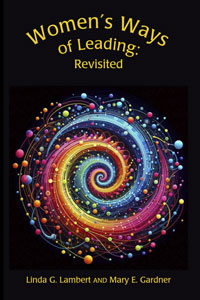
When I began to write fiction, I altered my web site from a singular focus on Leadership to “Literature and Leadership.” Since then, my posts have most often focused on one or the other—and, sometimes a blend of the two. Mary Gardner and I (with the assistance of our friend Maxine Greene) realized some time ago that “imagination” provokes and deepens compassion and empathy. Our imagination expresses itself in so many ways, especially through art and literature, creativity and innovation (see this lengthy discussion in our Women’s Ways of Leading). Clearly—without question—imagination is a nearly magical connection between leadership and literature. And, compassion and empathy ought to be our political litmus test.
A second critical bridge that links literature and leadership is the nature of narrative. By “narrative,” I mean here a written account of connected events—a story. Joanne Cooper has reminded us that stories express and remind us of who we are—they give meaning to our lives and contain the meanings of our histories. Yet stories are fluid, open to reinterpretation as we mature. Stories contain our metaphors of self. No group of peoples understand this better than Native Americans. Fortunately, Joanne and Mary will be contributing to the third edition of The Constructivist Leader.
Imagination and narrative—at this moment these two concepts stand out as essential links between literature and leadership. What do you think?
Linda
The Constructivist Leader Redux
October 30th, 2011
When the first edition of The Constructivist Leader was published by Teachers College Press, Columbia, it became a best-seller, used by top universities around the world. Why? This text proposed a new view of leadership that challenged centuries of tradition: leadership as interchangeable with leader; leadership as position and role of an individual with formal authority. The Constructivist Leader suggested that leadership was larger than leader and not a function of position and role. Leadership transcends formal authority to become a broader function of learning and culture: leadership as “reciprocal, purposeful learning in community.” Such learning is constructivist, rather than behaviorist, in nature.
In 2002, The Constructivist Leader, 2nd edition, was published smack in the early years of “No Child Left Behind.” As predicted, NCLB ushered in a sad decade predicated on testing in which our children became less educated, less inspired, less thoughtful.
Now, we have been asked to write a third edition. This edition promises to set straight the challenges to schooling, bringing constructivist learning and leading back into the limelight and into the schools. Once again we can resume our mission to create achieving and sustainable schools inhabited by children and adults who are critical and creative thinkers, problem-solvers, and responsible citizens.
Co-authors Deborah Walker, Diane Zimmerman, Joanne Cooper, Mary e Gardner and Morgan Lambert will be joined by remarkable educators Elizabeth Reilly, Linda Henke, Julie Biddle and Jan Huls-Nuno. If any of you have been pursuing this work in constructivist leadership, we would like to hear from you. E-mail me at Linlambert@aol.com. We’ll keep you informed as we move forward.
Next: Home again—what I’ve learned about literature and leadership. Linda
Emerging Themes: Taos: Song of the Loom
October 27th, 2011
When we left Taos last Friday, these questions and themes came along:
- What will anthropologist Justine Jenner, now entering the third novel in the Cairo Trilogy, find out about DH Lawrence that will inform her own sense of identity?
- How will conversations among key Taos characters, including Lawrence, Mabel Dodge Luhan, Frieda Lawrence, Carl Jung and Lady Dorothy Brett, set in the ‘20’s and ‘40’s, tell us about today’s realities?
- Can the case of the long-lost Lawrence will be revived in New Mexico—only if he had signed the deed for the Ranch that Mabel gave to his wife, Frieda? Did he?
- When Justine assumes her new job with the NM Office of Archaeological Studies, can she and her new boss find out: “How do we see Community?” And what does this have to say about the diverse Taos community and the thousand-year-old Pueblo?
- Did the peoples of the Four Corners, including Mesa Verde, migrate to the massive and long-abandoned Hupobi Pueblo?
- How will the Taos Pueblo Indians—the Red Willow peoples—influence Justine’s emerging spirituality?
- What struggles with the environment will challenge Justine’s strength and confidence in the shadow of personal tragedy?
- When a troubled Indian girl whom Justine has mentored nearly dies, can she be saved by the first Indian saint, Kateri Tekakwitha (who is yet to be canonized)?
- Will Amir El Shabry, Justine’s lover from Etruscan Evenings, survive the Egyptian revolution? And what does Egypt have to do with Taos anyway?
- How will the contextual issues of the history of Taos, drought, competition for water, suffering economy and the suffering art community inform this novel?
And much more….
Next: The Constructivist Leader redux, Linda
Larger than Chaco? Really? Hupobi Pueblo near Ojo Caliente
October 24th, 2011
Last Wednesday, we drove from Taos to Pilar through the incredibly enchanting Rio Grande valley smothered with golden cottonwoods to the Pueblo site near Ojo Caliente hot springs. As we approached the last leg of the trip to the giant plateau, we found that what was once a road was now a river. A river—ok, more like a wide, rapidly moving stream—that we would have to cross on foot. All of us.
Once there, archaeologist Paulo, Carmen, Hannah and I met four teachers and 50 seventh graders from Santa Fe who were nearly gleeful to forge a river on foot. I was less than enthusiastic, but soon became preoccupied with the mountain of loose rocks that lay between us and the giant plateau pueblo—larger than Chaco Canyon! My concerns about crossing the river gave way to my trepidation about that perilous mountain. I find it personally amazing what one can do when l) there is no choice, and 2) I had a walking stick. The kids scrambled through the icy water, yelping as they went. They were inspiring! This was an adventure to be had, mysteries to be encountered—yet perhaps never to be solved.
As we topped the mesa, the most glorious site lay before us: the layout of a massive pueblo protruding through the soil like muscles rising through a wet tee shirt. A yawning indentation of a massive kiva. Just beyond, over the ledge of the once-village, the Rio Ojo Caliente snaked through the luxurious valley below. The kids swarmed over the land picking up chards of pottery, black on white (making sure to replace them carefully). On a higher hill still, the stone frames for dry farming punctuated the land (why didn’t they plant near the river? Security concerns?) .
On the south ledge of the plateau, multiple petroglyphs covered huge stones. Unlike anything I’d seen before: stars in all sizes and shapes. A few years ago, a woman archaeologist camped out here and discovered that the site aims directly at Venus, perhaps the inspiration for the designs. Most things make sense if we look hard enough…right?
Of course the most compelling questions for any abandoned pueblo, city, or land are: where did the inhabitants come from and why did they leave? Apparently, these industrious peoples came in the late 1100’s and left around 1500, probably when disease ravished the tribe (multiple burials during a certain period are excessive). Paulo believes that they came from the four corners: Mesa Verde and Chaco. If so—and if this could be more nearly proven—it could resolve one of the most mystifying issues of archaeology. The timing, pottery, location and dry farming could suggest as much. How to find out?
A glorious day!
Next: emerging themes in the Taos research….Linda


The Cairo Codex, Linda's riveting Egyptian novel, is 
