Book talks and talks…Cairo Dairy and Women’s Ways of Leading
September 3rd, 2010
Tomorrow, I’ll be doing a “Meet and Greet” at Copperfields in Petaluma about Cairo Diary: an Egyptian fable, with Mary Gardner, my co-author on Women’s Ways of Leading. On August 15, Mary hosted a large and generous book talk at her home in San Jose for Cairo Diary…and another Meet and Greet took place at Copperfields in Napa on August 7 for both books. Book clubs in San Jose, Washington, D.C., Colorado, the Bay Area and the Sea Ranch, CA., are choosing Cairo Diary. Reviews have been excellent. A few appear below.
What are people saying about Cairo Diary: an Egyptian fable…
| Avid23 – See all my reviews |
This review is from: Cairo Diary: An Egyptian fable (Paperback)
Cairo Dairy merges the past and present in this modern day story of intrigue. Through an accident of fate, Justine, the heroine, finds herself with an ancient text that chronicles the life of a woman named Mary, the mother of Jesus. The diary portrays Mary as a thoughtful, caring, and literate woman juxtaposed against the backdrop of Jesus’ life in Egypt. Lambert deftly weaves ancient and modern Egypt into a travel diary of intrigue, love, and adventure. I highly recommend this as a must read for any one who loves Egypt and historical fiction.
Creative plot, timeless and timely messages, June 2, 2010
| By | Istari (Intermountain West) – See all my reviews |
This review is from: Cairo Diary: An Egyptian fable (Paperback)
Very interesting read. Found myself entertained by a novel with a unique plot and got bit of an education at same time. Author clearly has intimate personal knowledge of Egypt, and paints a detailed picture of the people and places. Themes introduced through character dialogs and story lines are both timely and timeless. A very different and worthwhile literary experience.
Rich in the history of ancient lands and religions, April 12, 2010
| By | Frequently Skeptical (Northern California) – See all my reviews |
This review is from: Cairo Diary: An Egyptian fable (Paperback)
The novel portrays the possible consequences resulting from the discovery of ancient writings indicating commonly held religious beliefs to be untrue. While the story and the characters hold interest, what makes the novel exceptional is the wealth of historical information concerning Egypt and the connections between, and the roots of, ancient Christianity, the Coptics, the Essenes and Islam. This alone makes for a fascinating read.
From Victoria, Canada
My enthusiasm for distinguished author Linda Lambert is undiminished. I mentioned your book (Cairo Diary) to some of the guests who were here for my granddaughter, Abby’s, wedding this past week. There were between 50 and 100 guests from New York, where Abby and Giles, the groom, live and work, and other guests from Texas, Tenn., California, etc…The most rewarding experience for an author is to KNOW that you have written a good book, and that perceptive readers will be able to share your story and enjoy your talent.
-David Appleby, Victoria, Canada
From Cairo, Egypt
I finished reading Cairo Diary and compliment you heartily for a creative and interesting book. At first I thought it was modeled after Dan Brown’s the DaVinci Code so I was put off. Then I thought it would be too Christian dogma oriented and so delayed reading it. When I finally started reading your book, I was fascinated. The parts that attracted me the most were what I surmised were biographical events entwined with the imaginary. I could well imagine you being Justine and recounting your actual life in Egypt. It became apparent why you mixed up the present with the past because you needed to have a story line and some conflict. Your characters were interesting. I had a chuckle through many of the events especially those related to the director of the Supreme Council of the Antiquities. I didn’t know that you knew that crowd! I found your use of names in the book quite interesting. You have made Morgan a part of your novel. You have probably included more real names from your life in Egypt. Fascinating.
Thank you very much for including me in the acknowledgments. That is an honor and I am humbled.
-Waguida El Bakery, Cairo, Egypt
From Seattle, Washington
Cairo Diary: an Egyptian fable is a stunning and daring novel. Intimate stories of Mary of Nazareth and her son Jesus, as well as other family members weave throughout the book, set in both the year 2 and 2006. Dr. Justine Jenner, an anthropologist, is trapped in an old crypt during an earthquake in Cairo and discovers an ancient codex, which turns out to be the diary of the Virgin Mary. Its revelations are shocking, rocking the religious and political world of the Middle East. For Justine, it is a journey of sexual awakening and a search for freedom. It is clear that Lambert knows Cairo and Middle Eastern history intimately and has woven this knowledge into a fascinating novel. A real page turner.
-John Sanders, Seattle, Washington
And, about WOMEN’S WAYS OF LEADING
Linda Lambert and Mary E. Gardner have crafted a wonderful book about the changing nature of leadership. While highlighting the vision and characteristics that women are bringing to the table, both sexes will find value throughout the book. The authors have included many tables (what I call shift papers) indicating both subtle and dramatic changes in what matters as one steps up to take a leadership role in shaping both the present and the future. Both the authors have “teacher” in their DNA and the book offers many mentoring stories and opportunities for young women just emerging on the stage of possibility. I am included in the book under the sub-title: The Transforming Woman. Here the concept of sapiential leadership is featured. It is an honor to be included within the folds of this book.
On Monday, Labor Day…our travels to Taos.
Why I Write.
August 8th, 2010
“We need to write to leave a stain upon silence.” –Samuel Beckett
Poetic, indeed: “a stain upon silence.” Such writing would be a legacy dearly to be wished. At the excellent Mendocino Writer’s Conference a week ago, Nancy Lord, an Alaskan writer, was a keynote speaker on the topic: Why I Write. I listened closely for familiar themes, personal reasons. Nancy noted that we tell each other stories in order to live, and in fiction we get to try out other lives. The purpose of all art, she said, is to lay bare our ways of being in the world. Listen to George Orwell’s reasons (1946) still so alive today:
• We write because it is something we just have to do. I want to see my words
in print. Egoism, he argued, as opposed egotism. Perhaps.
• Aesthetic enthusiasm…the pure pleasure of it…shaping words and ideas.
• A historical impulse-to make sense of the world.
• A political purpose-to push the world.
Annie Dillard insisted that in writing we find the compass inside ourselves.
Yesterday, I was joined by co-author Mary Gardner at Copperfields in Napa, California, for a “meet and greet” set of conversations. I spoke about and signed copies of Cairo Diary: an Egyptian fable; the both of us discussed Women’s Ways of Leading. Two young girls, ages 8 and 13, stopped by at different times during the afternoon; both said they were writers. I found myself regaling the wonders of writing: entering other worlds, choosing your roads for travel, the power of listening to your own voice. I know intimately that Nancy possesses the secrets of writing, as did Beckett, Orwell, Dillard, the two young girls, and our grandson, John Lambert. And, of course, Virginia Woolf.
Fiction is like a spider’s web, attached ever so slightly perhaps, but still attached to life at all four corners. Often the attachment is scarcely perceptible. (But it is always there)
-Virginia Woolf
Have a great week—and write something each day. More scenes from Cairo Diary next week. Linda
Cairo Diary III
August 1st, 2010
Hi,
Last night concluded this year’s terrific Mendocino Coast Writer’s Conference. Best ever. In a couple of days, I will enter a post Why I Write, adapting some ideas from the conference and the words of Alaskan Nancy Lord. One of the highlights: the gifts of Ellen Sussman. Watch for her work and classes.
Today, I’m making the third post on Cairo Diary. Here, Justine arrives in Cairo.
Chapter 4
What will you do with your one
wild and precious life?
-Mary Oliver
April 10, 2006 CE
The runway approach into Cairo International met the plane with jolting intimacy. Reaching for her briefcase and purse, Dr. Justine Jenner slipped into her now-snug shoes and stood up precariously, worming her way into a lightweight blue suit jacket. She was excited as well as apprehensive about what lay ahead. The community schools project would give her insight into today’s Egyptian girls, a chance to research the life of the Virgin Mary, as well as understand her own confusing roots. How am I to understand myself as a modern Egyptian woman? she wondered. Am I an heir of Isis, Mary, or today’s Islamic women cloaked in a hijab? These were the questions on her mind.
Extensive new construction cluttered the landscape below the plane and protruded into the thick ribbon of leather sky. Was there an airport in the world that wasn’t under construction? Justine waited patiently for passengers crowding into the aisles. The familiar chime signaled that everyone was free to go. “Free to go.” What an unfamiliar, though exhilarating, notion.
She had never really felt “free to go.” Raised by an Egyptian mother and a Berkeley professor father, she was often caught in the cultural crosscurrents of two stalwart individuals, both with immutable ideas about raising their headstrong daughter.
Justine’s mother, Lucrezia, had deliberately sought to marry an American, assuming she’d have a more emancipated marriage than she could have had with an Egyptian. She was wrong. Morgan Jenner, with his roots in the American Midwest, was more than moderately protective of his exotic Egyptian wife and young daughter. Each disappointing the other, her parents divorced shortly before Justine moved to Chicago for graduate school. Chicago was not the liberating solution she hoped. The endless demands of graduate work felt like a form of voluntary servitude. But here Justine was, for the first time, free of her father’s control…free of school…assuming her first professional position…free to go.
Linda
Scenes for Cairo Diary, III
July 25th, 2010
Justine arrives in Cairo…
Chapter 4
What will you do with your one
wild and precious life?
-Mary Oliver
April 10, 2006 CE
The runway approach into Cairo International met the plane with jolting intimacy. Reaching for her briefcase and purse, Dr. Justine Jenner slipped into her now-snug shoes and stood up precariously, worming her way into a lightweight blue suit jacket. She was excited as well as apprehensive about what lay ahead. The community schools project would give her insight into today’s Egyptian girls, a chance to research the life of the Virgin Mary, as well as understand her own confusing roots. How am I to understand myself as a modern Egyptian woman? she wondered. Am I an heir of Isis, Mary, or today’s Islamic women cloaked in a hijab? These were the questions on her mind.
Extensive new construction cluttered the landscape below the plane and protruded into the thick ribbon of leather sky. Was there an airport in the world that wasn’t under construction? Justine waited patiently for passengers crowding into the aisles. The familiar chime signaled that everyone was free to go. “Free to go.” What an unfamiliar, though exhilarating, notion.
She had never really felt “free to go.” Raised by an Egyptian mother and a Berkeley professor father, she was often caught in the cultural crosscurrents of two stalwart individuals, both with immutable ideas about raising their headstrong daughter.
Justine’s mother, Lucrezia, had deliberately sought to marry an American, assuming she’d have a more emancipated marriage than she could have had with an Egyptian. She was wrong. Morgan Jenner, with his roots in the American Midwest, was more than moderately protective of his exotic Egyptian wife and young daughter. Each disappointing the other, her parents divorced shortly before Justine moved to Chicago for graduate school. Chicago was not the liberating solution she hoped. The endless demands of graduate work felt like a form of voluntary servitude. But here Justine was, for the first time, free of her father’s control…free of school…assuming her first professional position…free to go…..
Scenes from Cairo Diary: an Egyptian fable
July 18th, 2010
Hi…Last week I said that I would be including a few scenes that are often part of a book talk about Cairo Diary: an Egyptian fable. In this scene, we meet Mary of Nazareth, mother of Jesus. Linda
Chapter 2
…there appeared an angel of the Lord to Joseph
in a dream, saying, ‘Rise, take the child and his
mother and flee to Egypt…
-Matthew 2:11
April 9, 2 CE
Sunlight skimmed across the water beneath a pale lavender mist as she watched the Great River come to life around her, warm sand rising between her toes. How long will these mornings be mine? Mary wondered. For nearly eight summers I’ve been free to come to this river alone, to listen to my own thoughts. At home in Palestine, my mother never felt the warm waters touch her skin, never traveled without a man at her side. Mary stepped into the river, embraced by the waters rising around her ankles.
As she watched, a white crane, startled by the approaching light, took flight. Hundreds of birds ascended in harmony while a single pelican swooped into the water, found its target, and emerged with a mouthful of squirming catfish. Mary’s attention moved to the glassy water below, where blue and white lotuses with toothed leaves offered temporary homes to restless grasshoppers and water beetles. Joseph moves slowly now and speaks of home. What will l say, what will I do, when the time comes to return to Palestine? Will my voice be heard?
The water nearby parted as two large protruding eyes joined by a gray leather mound surfaced into sunlight. An indifferent purple gallinule spread its wings and squatted between the hippo’s eyes. Colorful bursts of acacia, hyacinth, and oleander hugged the towering palms near Mary’s feet. As she deeply inhaled the fragrant air, she felt a wave of exhilaration. Although melancholy was often companion to her thoughts, she was grateful to God for these moments alone.
She knelt to catch some of the warm, clear water in her pot, slipping her sandy feet into worn leather sandals. Wet sand clung to the fringe on her tunic. She shook it to loosen the sand’s tight hold. The cloth would dry quickly.
As she leaned forward, her thick blanket of hair—not yet tamed for the day—was divided by a peak at the center of her forehead and framed an oval face tanned by the Egyptian sun. Two dimples deepened when she smiled. Her black eyes were especially alive and curious this morning. As a woman of twenty-four summers, she had grown into a rare beauty, far more beautiful than her modesty would allow her to comprehend. She was a woman with neither mirror nor vanity.
Scenes from Cairo Diary: an Egyptian fable
July 11th, 2010
A couple of days ago, I mentioned a recent book talk in Salida, Colorado, and am planning for three more book talks this summer (Napa, Petaluma and San Jose). I am going to post some of the scenes that I read during such a talk. Here is the first.
Cairo Diary: an Egyptian fable
April 12, 2006 Chapter One
Justine couldn’t wait. Nadia had offered to show her around Cairo, but she was too eager to set foot in the crypt under St. Sergius Church, a cave that had served as home to the Holy Family two thousand years ago. Tension gripped her body as she descended the thirteen worn steps down onto the marble floor below. She took each step with deliberate slowness to allow her body to absorb the holy site where the family once lived. Myth or fact…. or something in between? she mused.
Now inside the crypt, Justine continued to reflect upon the remarkable woman who had captured the imagination of the world. How did she raise her extraordinary sons? Where did Mary spend her nights? Where did Jesus sleep? She stood among the columns, her eyes sweeping over every nook and cranny looking for answers to the questions that drove her search.
The last time Justine was here, the crypt was closed because of groundwater that had seeped in after the ’92 earthquake. She could now see that the crypt, just recently reopened, had at one time served as a three-aisled chapel with an altar in the front wall. Justine ran her fingers across the smooth plastered walls surrounding four marble-crowned columns and supported by a roughly hewed ceiling. Primitive lights hung from each side of the room, the cords crawling back up the stairs. Shadows painted haunting images across the walls and ceiling. Perhaps ghosts or saints watch over this holy place, she thought. Not a religious person, nevertheless Justine could be swept up in the historical moment. In this moment.
Nearly four hundred kilometers to the east of Cairo, the morning sun danced a crystalline ballet across the Gulf of Aqaba. Deep below the shimmering waters, the Arabian plate snuggled up against the African plate as it had for millennia. This morning, the earthen plates quivered—only slightly. But enough. Suppressed energy, like flexing muscles, reached the tipping point. The quiver snaked itself west across the African plate, under the Sinai landmass, beneath the Gulf of Suez, and into the eastern Sahara creating a long ribbon of rupture. The quake hit Old Cairo some 90 seconds later.
Media, Granddaughters and Learning
July 10th, 2010
I confess that I have skipped a week in my posting. Morgan and I were in Colorado at a family reunion and time slipped by…. Five granddaughters contributed to the delicious distractions and opportunities for some new learning. It won’t surprise anyone that the world of young girls consists heavily of media use, especially texting and Facebook–and movies played on the computer. Making sense of this brave new world is challenging at best.
Our granddaughter Keely is a sophomore in communications and design at CSU, Chico, and was able to shed some light from her own understandings of this media world. In a recent course, she learned to find her own voice (how useful is that!) in writing a blog; in fact, the final was to write a post on a given topic. It is reassuring to know that identity may not get lost in the shuffle. (Three other granddaughters there are also interested in the uses of communication, design, language, marketing.) Another concept that Keely told me about is “pancaking,” or thin layers of knowledge gained in short visits to Google sites. Now pancaking deeply concerns me, although I have faith in the mind to synthesize and create knowledge and patterns from disparate fragments of information.
Two concerns regarding this media world pray on my consciousness: FIrst, the attention given to texting while the world around is glistening with drama, life, conversation, music. The failure to be in the moment. Life can pass us by so quickly when we don’t attend. What must the effects be on the human brain when “now” is elsewhere? What about the Power of Now?
Secondly, on arriving home I read David Brooks NY Times article (7/9/10) about the Medium is the Medium and leaps in learning by disadvantaged children when given 12 books for the summer. Dramatic results. David suggests that what matters most is the way people think of themselves…and thinking about yourself as a reader means self-identity as an educated, cultivated master of significant things. The challenge he poses is: how to build an Internet (I would add Media) counterculture that will better attract people to serious learning. I don’t think we are there yet. Yet it is highly encouraging when granddaughters enter into reflective conversations about the effects of the very medium that captivates them and their peers.
Further, I was gratified that when I gave book talks on Cairo Diary: an Egyptian fable and Women’s Ways of Leading at Salida’s charming bookstore, Bookhaven, last Tuesday all of the granddaughters were graciously attentive. No texting in sight.
More on Monday next….
A New Feminism? Not quite.
June 28th, 2010
Without the reciprocity inherent in fraternity, ascendancy
into a full intellectual and activist life could not occur.
-Simone de Beauvoir
Once conform, once do what other people do because they
do it, and lethargy steals over all the fine nerves and faculties
of the soul.
-Virginia Woolf
In Women’s Ways of Leading, Mary Gardner and I refer to these realizations as the “awakening.” Both reciprocity and independence are the essence of life, of leadership, of entry into full civic and moral responsibility. The recent ascendence of conservative women has been dubbed by some as “a new feminism.” Religious and formerly quiet women are rising to the call of Sarah Palin, the new Elmer Gantry. Tea Party advocates of “no government” are pulling up women from the radical right who would trample the civil liberties of anyone who doesn’t agree with them. Even independent, strong and successful women such as Carly Fiorina and Meg Whitman are riding the wave with strange bedfellows.
Why not call it a new feminism? I would offer a few reasons:
- Feminism is about equal access to opportunity and engagement in civic life.
- Feminism is about compassion for the less fortunate, with the full intent of raising all ships into a good quality life.
- Feminists want their daughters and granddaughters to think, not follow.
- Feminism is about control over one’s own body and choices. Determination of the “right” to hand over control of a woman’s body or relationship such as marriage to outside authorities such as the government or church is in direct contradiction to the “no government in our lives” mantra. Yes, Virginia (Woolf), these women are advocating just that.
- Feminism is about influencing the world through positive means, modeling responsible action without destroying those who would work with us.
- Feminism is about independent thought, not following dogma.
Yet, is it possible that, once women begin to become involved, even in questionable ways, that a real awakening could be in the offing? This morning my friend, Jeanne, reminded me that the majority of students in colleges today are women, so this may be the major path to awakening. Could this be a transition to unveiling the mind? I don’t know, but I’m sure thinking about it.
The education system should be founded on “unveiling the mind.” Unveiling means to remove the mask of ignorance and unquestioning compliance to reveal the inner power and knowledge….Women throughout the world, wisely awakening to this call for unveiling, find strength in their values and in themselves.
-Nawal El Saadawi, Egyptian feminist and author
Women are excited about…
June 15th, 2010
The workshop in Genting was an eye-opening affair
for me. I discovered that I do have leadership quali-
ties. It is alarming as well as exhilarating. Alarming
because I fear the responsibility that comes with it…
Exhilarating because I now realize that I can make a
difference…
Sharifah Hadjarah Aziz, Malaysia as
Quoted in Women’s Ways of Leading
We have found that when leadership is viewed as the capacity to engage in reciprocal, purposeful learning in community, the notion of leadership is moved into the network of learning relationships in an organization (see The Constructivist Leader, 1995, 2002). This notion of leadership relies on equitable relationships, the exercise of collaboration, moral purpose and engaged learning communities. Women have a natural inclination for this way of being in the world.
As we’ve given book talks about Women’s Ways of Leading, we’ve found that women are especially enthralled with our definition of leadership…and have come to realize that the sum total of the book is greater than its parts. In other words, epiphanies are longitudinal. That said, these are a few of the most compelling additional features:
• Brain research suggesting that women are uniquely wired to lead.
• A Framework of Women’s Leadership Development (chart of themes and perspectives)
• Themes that govern women’s leadership (Values, Evolving Self, Passion and Courage, Imagination, Community, and Mentoring)
• Stories of women at difference stages of development
• Skills and Understanding for Women’s Ways of Leading (chart)
• Women to Watch
• Historical Timeline of Women’s Rights in America
Next Monday we’ll say more about Women to Watch. Linda and Mary
Women Who Lead Commit to Values
June 14th, 2010
Values, as I suggested yesterday in the post on Steinbeck, are the genesis of leadership. We believe that values form each person’s identity. Today, Mary Gardner and I are sitting in my living room examining the role that values play in the lives of women leaders. We thought we’d start by reviewing our thoughts from Chapter 2 of Women’s Ways of Leading:
Values can be as nebulous and as mystical as leadership itself. Yet it is values that describe who women are and what women stand for in the world. By defining Leadership as “reciprocal, purposeful learning in community,” purpose or values form the heart of leading, as they are the heart of learning. The notion of universal values—principles or strongly held beliefs—turns attention toward human rights ideals such as peace, caring, equality, universal literacy, women’s and children’s rights, democratic citizenship and environmental care.
Linda: Mary, isn’t this as true for men?
Mary: Certainly, men such as Steinbeck, lead lives shaped by values; however, our research—you will recall—on the neurobiology of women indicate that women are uniquely suited to claim values such as empathy, caring, equity…
Linda: In other words, women negotiate the value journey somewhat differently?
Mary: Exactly. Nel Noddings suggested that the value of caring is a significant lens through which women, particularly, attribute meaning to experiences, build relationships and frame action.
Linda: Yes, for instance, she encouraged teachers to give themselves permission to care about their students and other teachers, and to develop strategies for building reciprocal caring among students.
Mary: And, Carol Gilligan pointed out that caring is the key value in the moral development of women.
Linda: So, the trick is to figure out how those fires get lit for women to translate caring into the leadership actions.
Mary: And in Women’s Ways of Leading stories exemplify how these fires get lit…
Linda: And our reflective questions engage women in the exploration of their own lives and how values give them strength, direction and focus.
‘Til tomorrow.


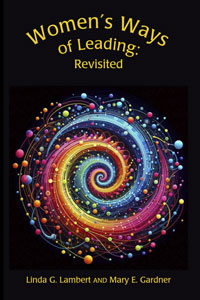
Women's Ways of Leading invites the reader into a journey of self-discovery informed by a fresh definition of leadership that transcends position, role and hierarchy and proposes leadership as reciprocal learning in purposeful communities.
Cairo Diary: An Egyptian Fable is a tale of two women 2000 years apart: the Virgin Mary, living with her family in Old Cairo; and Dr. Justine Jenner, an anthropologist. During a violent earthquake, Justine becomes trapped in the crypt under St. Sergius Church, the cave that served as the Egyptian home to the Holy Family. When the shaking stops, the diary of the Virgin Mary lies at her feet. When Linda visited this ancient crypt, she was inspired to write Cairo Diary: An Egyptian Fable, her first historical novel.